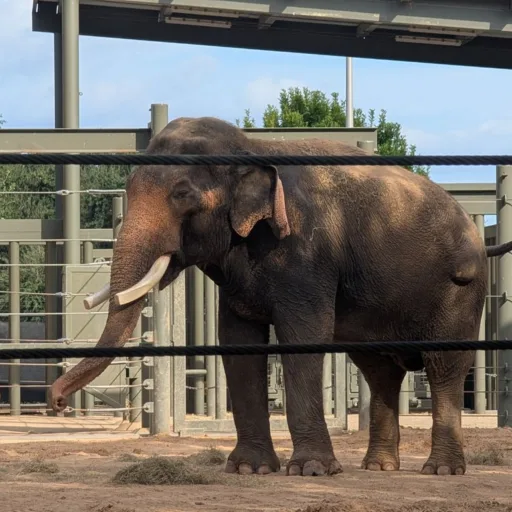
Thailand
Houston Zoo (Houston, TX)
Thailand is an Asian elephant (from Thailand) who has suffered under human control for 59 years. Torn from his familial herd when he was just two years old, since 1980, Thailand has spent more than four decades confined at the Houston Zoo, where he has been used for breeding, put on public display, and subjected to behavioral control. Thailand is currently confined with other elephants, including his offspring, who all suffer from their facility’s lack of sufficient space and from being unable to engage in their natural behaviors.
Thailand's Story
Thailand is an Asian elephant (from Thailand) who has suffered under human control for 59 years. Torn from his familial herd when he was just two years old, since 1980, Thailand has spent more than four decades confined at the Houston Zoo, where he has been used for breeding, put on public display, and subjected to behavioral control.
Thailand was previously held in a traveling circus alongside other elephants, made to perform for human entertainment. That early captivity marked the beginning of a life defined by coercion and subjugation.
At the Houston Zoo, Thailand has participated as an involuntary subject in the AZA’s captive elephant breeding program, designed to produce the next generation of elephants in captivity. His body has been used to father at least 20 calves with multiple females, including Tess and Shanti. Several of his offspring—such as Tilly, Tupelo, and Joy—remain at the Houston Zoo, while others have been transferred to different facilities, continuing the cycle of confinement across zoological institutions. Thailand’s genetic lineage has extended to a second generation, with grandchildren, all dying, born as a direct result of his use in breeding programs.
In the wild, male elephants seek out mates across vast landscapes on their own terms, forming and leaving associations freely; they have basic sexual autonomy. By contrast, reproduction in captivity is orchestrated through human management, with bulls like Thailand selected, controlled, and used for their genetics. It is immensely harmful. Artificial insemination, controlled introductions, and forced proximity replace natural choice, and calves are often separated from their mothers or shuffled between facilities as part of population management strategies. Thailand’s offspring are fated to a cruel existence: unnatural lives defined by confinement, transfer, and instability.
Despite being a bull elephant naturally inclined, due to his biology, to roam independently and travel great distances,Thailand’s movements are tightly controlled and restricted. He is housed within a managed herd structure that shifts based on institutional priorities, at times placed with females and calves and at other times separated or held alone in off-exhibit spaces. These arrangements are not guided by his preferences; they are governed by breeding decisions made by humans, space constraints, and management convenience.
Like many captive elephants, Thailand has been conditioned to perform behaviors framed as “enrichment” or “exercise,” including stretching and positioning his body on cue—activities sometimes likened to “yoga” in zoo messaging. These behaviors are not expressions of choice or well-being. They are the result of training and control, developed to facilitate handling and reinforce compliance, and used as publicity stunts to obscure the harmful reality of captivity.
After almost sixty years under human control, Thailand remains confined to a space that cannot meet his most basic physical and psychological needs. Stripped of all dignity, he exists to entertain humans, to sustain a profit-driven breeding program, and to perpetuate a cruel system that denies elephants their autonomy.
Thailand is not a thing, despite having been treated as such. He is an autonomous being entitled to flourish according to the needs of his biology, which requires having the freedom to make meaningful choices about his own life. He should not be bred, displayed, or confined for human purposes. He should be free.
Take action today
A future where no elephant has to endure the traumas of being torn from their families and natural habitats, bred against their will, and shipped from zoo to zoo is possible, and we need your help to make it a reality.
Submit Information
Do you have a tip for us? The Free to be Elephants project relies on our supporters to keep us up-to-date with the latest news, updates and photos about elephants in their local facilities. Use this form to submit your info and help us expose the reality of elephant captivity across America.


