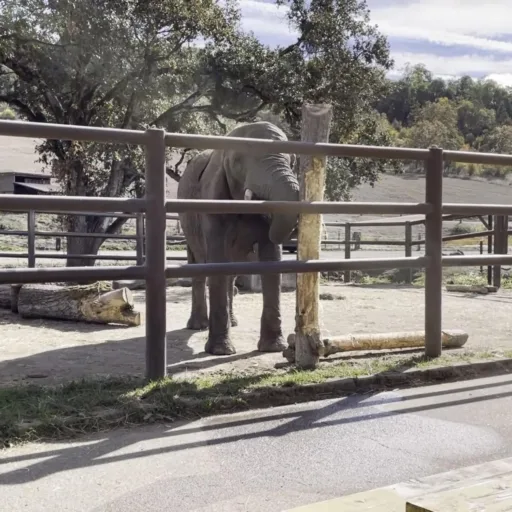
Moja
Wildlife Safari (Winston, OR)
Moja is a female African elephant born in captivity at the San Diego Zoo Safari Park in 1982. In 1994, she was transferred to the Pittsburgh Zoo & Aquarium, where she spent twenty years on display and was used in the zoo’s captive elephant breeding program. During that time, she gave birth to two daughters, Victoria and Zuri. Then, in 2014, the zoo sent Moja across the country to Wildlife Safari in Oregon, permanently separating her from them. She remains confined at Wildlife Safari with other elephants who all suffer from the facility’s lack of sufficient space and from being unable to engage in their natural behaviors.
Moja's Story
Moja is a female African elephant born in captivity at the San Diego Zoo Safari Park in 1982. In 1994, she was transferred to the Pittsburgh Zoo & Aquarium, where she spent twenty years on display and was used in the zoo’s captive elephant breeding program. During that time, she gave birth to two daughters, Victoria and Zuri. Then, in 2014, the zoo sent Moja across the country to Wildlife Safari in Oregon, permanently separating her from them. She has remained confined there ever since.
For female elephants, family is the center of their lives. In the wild, female elephants live in tightly bonded families led by mothers and grandmothers. Daughters stay with their mothers for life. They raise calves together, travel together, defend one another, and build relationships that last decades. Young elephants learn who they are through those relationships. Family is how elephants experience safety, belonging, and stability in the world.
Moja’s life was shaped by human decisions instead. People decided where she would live. People decided she would be bred. And people decided her family could be separated.
When Moja was transferred to Oregon, Victoria was fifteen years old and Zuri was only six. In the wild, neither daughter would have left her mother. The separation was not temporary or necessary for survival. It was a management decision made by institutions treating living, emotionally complex beings as interchangeable assets to move between facilities.
Today, Moja lives hundreds of miles away from her daughters. That loss matters because elephants form deep, lifelong bonds with their families. They recognize one another after years apart, remain closely attached to family members across decades, and show visible signs of distress when loved ones die or disappear. Their relationships shape the structure of their entire lives.
No enclosure can replace what was taken from Moja. She has spent more than forty years living within boundaries imposed upon her by humans—unable to choose where to go, whom to live with, or how to live. As she grows older, she deserves the chance to spend the rest of her life in a sanctuary, where she can experience greater space, greater autonomy, and a life shaped more by her own choices than by captivity.
Take action today
A future where no elephant has to endure the traumas of being torn from their families and natural habitats, bred against their will, and shipped from zoo to zoo is possible, and we need your help to make it a reality.
Submit Information
Do you have a tip for us? The Free to be Elephants project relies on our supporters to keep us up-to-date with the latest news, updates and photos about elephants in their local facilities. Use this form to submit your info and help us expose the reality of elephant captivity across America.


