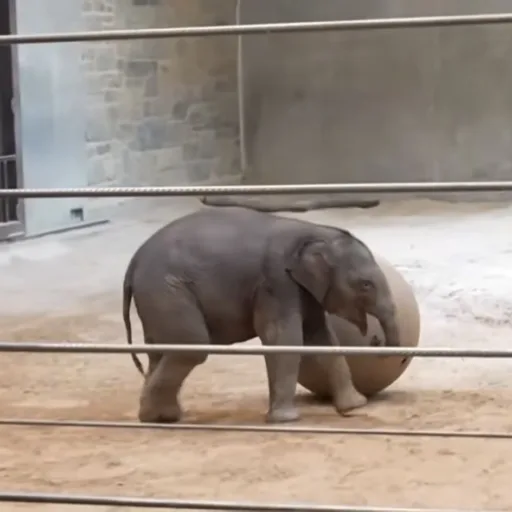
Linh Mai
Smithsonian National Zoological Park (Washington, DC)
Linh Mai is a female Asian elephant born in February 2026 at the Smithsonian’s National Zoo. Shortly after her birth, Linh Mai’s mother, Nhi Linh, rejected her—a heartbreaking outcome that regularly occurs in captive elephant populations. As a result, Linh Mai required intensive human intervention to survive. She was bottle-fed around the clock, handled by zoo staff, and gradually introduced to another elephant who assumed a surrogate caregiving role. While these efforts have been portrayed as a conservation success, they reflect the profound failure of captive breeding and highlight the challenges faced by elephant calves who are forced to grow up in a wholly unnatural environment, fundamentally unlike the one evolution prepared them for. Linh Mai is confined with several other elephants, who all suffer from their facility’s lack of sufficient space and from being unable to engage in their natural behaviors.
Linh Mai's Story
Linh Mai is a female Asian elephant born in February 2026 at the Smithsonian’s National Zoo. Unlike wild elephant calves, who are born into large, multigenerational families and remain almost constantly at their mothers’ sides while being cared for by sisters, aunts, and grandmothers, Linh Mai entered the world in captivity—through a breeding program designed to produce future generations of zoo elephants.
Shortly after her birth, Linh Mai’s mother, Nhi Linh, rejected her—a heartbreaking outcome that regularly occurs in captive elephant populations. As a result, Linh Mai required intensive human intervention to survive. She was bottle-fed around the clock, handled by zoo staff, and gradually introduced to another elephant who assumed a surrogate caregiving role. While these efforts have been portrayed as a conservation success, they reflect the profound failure of captive breeding and highlight the challenges faced by elephant calves who are forced to grow up in a wholly unnatural environment, fundamentally unlike the one evolution prepared them for.
Linh Mai was not born as part of a program to restore wild elephant populations. She is a product of the Association of Zoos and Aquariums’ Species Survival Plan, a closed captive breeding program that is designed to perpetuate elephant populations in zoos. No elephant born in a U.S. zoo has ever been released into a wild herd.
Generations of captivity characterize Linh Mai’s family history. Her mother was born at a zoo in the Netherlands to captive-born elephants. Her father, Spike, was born at a zoo in Florida. Linh Mai is part of a captive lineage in which elephants are bred, transferred between facilities, and managed to meet institutional breeding goals—all to the detriment of their fundamental interests.
As she grows older, every significant aspect of Linh Mai’s life will remain under human control. She will not decide where and how she lives, which elephants she spends time with, or whether she has calves of her own. Like other zoo-born elephants, she may one day be transferred to another institution to satisfy breeding recommendations, continuing the same cycle of deprivation that characterizes life in captivity.
In the wild, female elephants live within lifelong family groups, traveling many miles each day while making countless decisions about where to go, what to do, and with whom to spend their time, and develop rich social relationships that endure for decades. These opportunities to direct the course of their own lives—to exercise autonomy—are essential to elephant well-being. Captivity cannot provide them.
Linh Mai’s story has been presented by the zoo industry and media as one of hope, contrary to the cruel reality of her existence. She was born into a system antithetical to the interests of elephants, one from which there is no path to freedom in the wild and that will deprive her of meaningful control over every aspect of her future. Her life is a reminder that securing the future of elephants depends on protecting them in the wild, preserving their natural habitats, and recognizing these cognitively complex, autonomous beings for who they are—individuals entitled to live freely as elephants, not objects bred for human curiosity.
All elephants deserve to live in an environment that respects their inherent interests, one capable of providing the space and freedom to meet their complex physical and psychological needs. Linh Mai, along with the other elephants confined at the Smithsonian’s National Zoo, should be relocated to an elephant sanctuary where they can have lives of dignity.
Take action today
A future where no elephant has to endure the traumas of being torn from their families and natural habitats, bred against their will, and shipped from zoo to zoo is possible, and we need your help to make it a reality.
Submit Information
Do you have a tip for us? The Free to be Elephants project relies on our supporters to keep us up-to-date with the latest news, updates and photos about elephants in their local facilities. Use this form to submit your info and help us expose the reality of elephant captivity across America.


