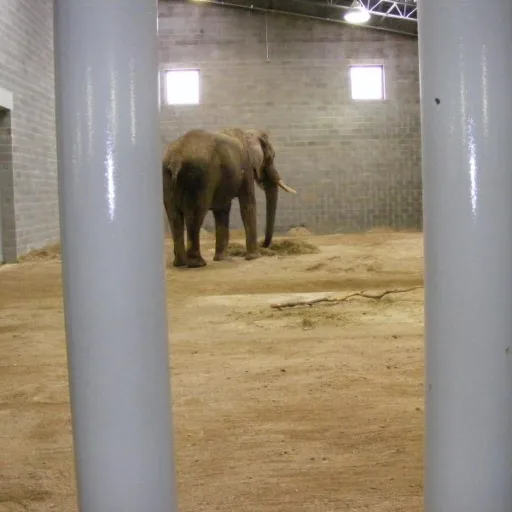
Jackson
International Conservation Center (Fairhope, PA)
Jackson is a male African elephant born wild in Zimbabwe in 1976. Like so many of his generation, he began his life in freedom—in a family herd, surrounded by relatives, roaming a vast, complex landscape that shaped every part of who he was. That life was stolen from him when, in 1978, humans captured and exported him to the United States. He was two years old. Now nearly 50 years old, separated from his original family, Jackson is confined at the International Conservation Center, where he is deprived of meaningful choice and used in a breeding program that perpetuates suffering for future generations of elephants.
Jackson's Story
Jackson is a male African elephant born wild in Zimbabwe in 1976. Like so many of his generation, he began his life in freedom—in a family herd, surrounded by relatives, roaming a vast, complex landscape that shaped every part of who he was. That life was stolen from him when, in 1978, humans captured and exported him to the United States. He was two years old.
For the next sixteen years, from 1978 to 1994, Jackson was repeatedly bought, sold, and transferred between circuses and private owners. During this period—an era marked by widespread use of bullhooks, coercive training, and brutal handling norms—Jackson endured severe deprivations of his autonomy, while living in conditions that no elephant should ever experience. Deprived of space, companionship, and stability, he grew up in unnatural environments in service of human entertainment and commercial use.
In 1994, at age 18, Jackson was transferred to the Pittsburgh Zoo. The zoo, long steeped in controversy over its elephant program, would become the central institution controlling his life for the next three decades—either directly or through its offsite breeding facility, the International Conservation Center (ICC). Jackson remained there until 2001, when he was crated and shipped to Disney’s Animal Kingdom for captive breeding. In 2004, he was sent back to Pittsburgh. In 2008, Jackson was moved to the ICC, a remote breeding compound where he has lived ever since.
Across these moves, Jackson’s life reflects a pattern seen throughout zoo captivity: he has been treated as a piece of reproductive infrastructure, rather than an autonomous, emotionally-complex being with profound social needs. He has been subjected to the AZA’s invasive, coercive captive-breeding system, in which male elephants are routinely forced to mate, isolated for semen collection procedures, and moved with little regard for the trauma inflicted by separation and transport.
Jackson has sired 18 offspring, only eight of whom are still living. His surviving children are imprisoned at zoos in Pennsylvania, Kansas, Florida, and Missouri. His lineage continues to be exploited: at least four of his offspring, Nadirah, Callee, Victoria, and Zuri, are now being subjected to forced breeding themselves. Nadirah has a daughter at Disney’s Animal Kingdom. Callee—Jackson’s son, who has never known life outside captivity—has nine living children confined at zoos in Kansas and Nebraska.
According to the Pittsburgh Zoo, Jackson is tied to nearly 50% of African elephant births in North America over the past decade. Far from being a point of pride, this statistic exposes the profound ethical bankruptcy of captive breeding programs. It reflects not success, but exploitation—a system built on a single elephant whose genetic material is repeatedly used because there are so few African elephants left in American zoos to breed.
Nothing about Jackson’s story resembles conservation. Removing him from the wild did not help wild elephants. Forcing him to produce generation after generation of elephants who will suffer and die behind bars has not protected his species. From a “conservation” standpoint, all that’s been accomplished is an expansion of the population of exploited elephants held captive for exhibition, revenue, and breeding quotas.
In the wild, Jackson would have reached full social maturity in his 30s and participated in a dynamic society of male elephants—choosing where to roam, whom to associate with, and how to navigate complex elephant relationships. Instead, every turning point in his life has been controlled by human institutions that deny elephants even the most basic expression of their autonomy.
Now nearly 50 years old, separated from his original family, Jackson continues to be confined at the ICC, where he is deprived of meaningful choice and used in a breeding program that perpetuates suffering for future generations of elephants.
Jackson is a prisoner—not by metaphor but by fact. He has never been seen as an individual with rights, only a “thing” whose value lies in how many elephants he can be forced to produce. Lacking the fundamental right to freedom, his life is a stark example of why captive breeding programs must end.
May Jackson, his children, his grandchildren, and the countless elephants harmed by this system one day find refuge at accredited sanctuaries where they can reclaim that which has been denied to them: the ability to live with dignity, autonomy, and peace.
Take action today
A future where no elephant has to endure the traumas of being torn from their families and natural habitats, bred against their will, and shipped from zoo to zoo is possible, and we need your help to make it a reality.
Submit Information
Do you have a tip for us? The Free to be Elephants project relies on our supporters to keep us up-to-date with the latest news, updates and photos about elephants in their local facilities. Use this form to submit your info and help us expose the reality of elephant captivity across America.


