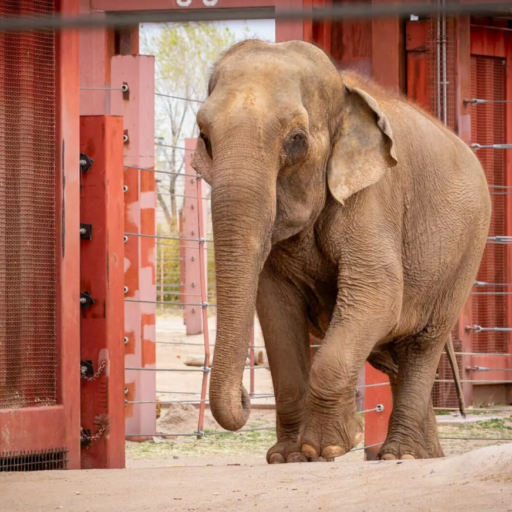
Alice
Albuquerque Biological Park (Albuquerque, NM)
Alice is a female Asian elephant born in the wild in Asia around 1974 who was captured as a young calf and brought to the United States, where she has spent nearly her entire life in captivity at the ABQ BioPark. In the wild, elephants live in complex social groups and move freely across vast landscapes—yet Alice was taken from that world as a calf. Instead, she has spent decades in a barren, artificial enclosure spanning just a few acres, confined to a manufactured social grouping where the autonomy, stimulation, and complexity of elephant life cannot exist. Within this confined world, she has endured profound loss, including the deaths of her grandchildren. After a lifetime defined by confinement, loss, and the absence of choice, Alice has been denied the opportunity to live as an elephant—and deserves the chance to spend her remaining years in a sanctuary where she can finally experience autonomy, dignity, and peace.
Alice's Story
Alice is a female Asian elephant born in the wild in Asia around 1974. Captured as a young calf and brought to the United States, she arrived at the ABQ BioPark in 1976 and was transferred to the San Diego Zoo Safari Park in 1987. In 1991, she returned to the ABQ BioPark where she has remained confined ever since. Now over 50 years old, Alice has spent nearly her entire life in captivity.
In the wild, female Asian elephants live in tightly bonded, multigenerational matriarchal societies. They learn from their mothers and grandmothers how to navigate their ever-changing environment, read the land, and build the relationships that sustain for decades. While traveling vast distances across landscapes, they make complex decisions about where to go, what to eat, and how to care for one another. These experiences are essential to what it means to be an elephant. Yet Alice was transported across the world before she could experience any of it.
In captivity, Alice lost her entire developmental foundation—the knowledge passed down through generations, the intricate social bonds that shape identity, and the opportunity to move through natural landscapes. In a life defined by the absence of choice, she has been placed in an exploitative system centered around human desires, human schedules, and human ideas about how to use elephants for various ends.
Today, Alice lives in a barren, artificial enclosure spanning just a few acres, a fraction of the hundreds of square miles wild elephants roam. No matter how well designed, such space cannot replicate the autonomy, stimulation, or complexity of life in the wild. There is no interesting terrain to read, no great distances to navigate, no meaningful decisions to make about where to go or what to do. The physical and psychological dimensions of elephant life—the kind built over millions of years of evolution—simply cannot exist within zoo walls.
Alice is confined with her daughter Rozie, who was born at the zoo in 1992. This is not a normal elephant family structure. In the wild, matriarchs lead large, multigenerational herds of related females, forming dynamic, lifelong bonds shaped by shared experience and mutual care. Alice’s social world has been reduced to a small, artificially constructed grouping dictated by human management decisions. Completely absent is the richness of elephant social life, replaced by forced physical proximity shaped by space limitations.
Within her confined world, Alice has endured shattering losses. Her grandchildren Daizy, Thorn, and Jazmine all died from elephant endotheliotropic herpesvirus (EEHV), a disease with no reliable cure that has devastated captive elephant populations. In December 2024, Alice stood near Rozie as her daughter delivered a full-term stillborn calf, remaining close by as Rozie attempted to rouse her baby. These are not abstractions. For decades, Alice has watched the small family she was allowed to have diminish around her.
Captivity has affected Alice’s health as well. In 2010, she tested positive for tuberculosis, a disease linked to the close-quarters conditions of zoo management and one that further illustrates the physical toll of a lifetime in confinement. Even unusual moments that zoos frame as routine or downplay, like Alice briefly escaping her enclosure in 2026, point to a deeper reality: elephants are autonomous beings who desire to move freely through the world.
Alice has spent over five decades in a monotonous, unnatural environment that cannot meet her physical, psychological, or social needs. She has been denied the possibility of a flourishing life meant for elephants. As she enters her golden years, the question is not whether captivity has failed her—it is whether that failure will be allowed to continue. Alice deserves to spend her remaining time in a sanctuary where she can experience what has been unjustly denied to her: the freedom to choose how to live her life.
Take action today
A future where no elephant has to endure the traumas of being torn from their families and natural habitats, bred against their will, and shipped from zoo to zoo is possible, and we need your help to make it a reality.
Submit Information
Do you have a tip for us? The Free to be Elephants project relies on our supporters to keep us up-to-date with the latest news, updates and photos about elephants in their local facilities. Use this form to submit your info and help us expose the reality of elephant captivity across America.


